

Artificial Intelligence (AI) is rapidly evolving from an experimental technology into an integral part of modern business operations. While financial institutions and other organizations initially focused on exploring the technical possibilities of AI, attention is now shifting toward a far more relevant question: how can organizations create sustainable value with AI within existing governance, risk, and performance management processes?
For executives, boards, and regulators, the challenge is no longer whether to use AI, but how to integrate it responsibly into the way organizations are governed and managed. This is where governance, risk management, and performance management converge.
From Data to Better Decision-Making
Organizations today have access to vast amounts of data. At the same time, many executives struggle to extract the right insights quickly enough to support effective decision-making. Performance indicators, risk information, compliance data, and operational metrics are often spread across multiple systems and reported separately.
AI offers the ability to identify patterns, anomalies, and relationships that were previously difficult to detect. However, real value is only created when these insights are directly connected to decision-making processes. Not as standalone dashboards or isolated experiments, but as part of an integrated management cycle where strategy, execution, risk, and monitoring are connected.
As a result, AI is shifting from being a provider of information to becoming a true decision-support capability.
Governance as the Foundation
The growing adoption of AI also introduces new responsibilities. Organizations want to benefit from predictive analytics and automation, but they must also be able to explain how decisions are made and who remains accountable for them.
This makes governance a critical prerequisite for successful AI adoption. Transparency, ownership, validation, and control must be embedded into AI initiatives from the outset. Particularly in regulated sectors such as financial services, where risk management, compliance, and accountability are essential, trust is just as important as technological innovation.
The emergence of new regulations, including the European AI Act, further reinforces this trend. Organizations are increasingly required to demonstrate that AI systems are deployed responsibly and that outcomes remain transparent, auditable, and explainable.
Integration Over Fragmentation
One of the most significant developments in AI adoption is the shift away from standalone AI solutions toward integrated approaches. The real challenge is not generating more insights, but connecting those insights to existing business processes and responsibilities.
When strategy, risk, compliance, and performance are managed separately, fragmentation occurs. AI may provide valuable analysis, but the broader context is often missing. In an integrated environment, organizations gain a consistent and holistic view in which objectives, KPIs, risks, controls, and policies are connected. In this context, AI acts as an accelerator and enhancer of existing governance structures rather than a replacement for them.
From Insight to Action: A Practical Example
Consider a financial institution that monitors strategic objectives through KPIs while managing risks, compliance requirements, and operational processes in separate systems. In many organizations, relationships between these domains only become visible during periodic reporting cycles.
Within an integrated Governance, Performance, Risk, and Compliance (GPRC) platform, these components can be brought together into a single operating model. AI continuously analyzes the relationships between strategic objectives, performance indicators, risks, controls, and policy frameworks.
When a critical KPI begins to underperform, the system can automatically identify which risks or operational developments may be contributing factors. AI can also assess the potential impact on strategic objectives, regulatory obligations, or future business performance. As a result, executives receive not only an alert but also valuable context, root-cause insights, and actionable recommendations.
The strength of this approach lies in the combination of technology and governance. AI is not deployed as a standalone analytical tool but as part of an integrated management framework where decisions are based on a single source of truth. This enables organizations to respond earlier, manage risks more effectively, and improve overall performance monitoring.
From Experimentation to Sustainable Value
Many organizations have moved beyond the pilot phase of AI adoption. The question is no longer what AI can do, but how it can be scaled across day-to-day management and governance processes.
Achieving this requires more than technology alone. Successful implementation depends on a strong governance foundation, reliable data, clearly defined responsibilities, and an integrated approach where strategy, risk, compliance, and performance reinforce one another.
Organizations that succeed in this transformation do not view AI as an objective in itself. Instead, they use it as a tool to make better decisions, strengthen resilience, and respond more effectively to a rapidly changing environment.
Conclusion
The evolution of AI within governance and performance management demonstrates that its greatest value does not come from technology alone, but from the way it is embedded into existing management and control processes.
The organizations that will stand out in the coming years are not necessarily those with the most advanced AI capabilities, but those that successfully connect AI to strategy, risk, compliance, and performance management. This is where AI moves beyond the hype and delivers practical business value: as part of an integrated operating model that enables organizations to make better-informed decisions, maintain control over risk, and achieve strategic objectives more effectively.
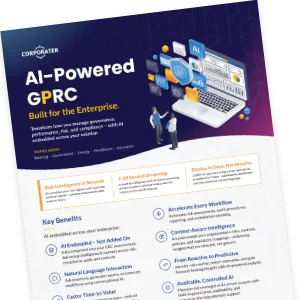
AI-Powered GPRC – Built for the Enterprise